Thursday, February 26, 2015

What comes first, the technology or the curriculum

Things have come a long way since my 3rd grade teacher had to thread a film into a movie projector.
Using technology is not a cheap parlor trick where the technology is the trick and the students are amused. Almost all (good) technology measures student progress and some of it happens right in the middle of a lesson with instant feedback. In an article by Elise Ecoff, she talks about this and how technology must enhance the curriculum and not entertain your students with suggestions on how you can make technology work for students at home and in the classroom.


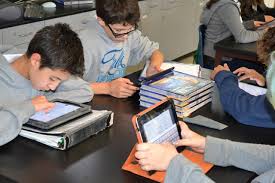
Image result for students using technology in the classroomIt’s hard to imagine now, but there was a time when handing a student a calculator to work through algebraic equations caused many teachers and parents great consternation. It makes you wonder what type of pushback the creators of the abacus faced! In both cases, while the tools students were using may have been more advanced than previous generations’, the goal remained the same – to enhance classroom learning.
But before moving forward with technology integration, every school must first have a great, robust and adaptable academic curriculum. Only then can you begin to find ways in which technology can help to elevate it. It’s important to never force fit technology – if it’s not supplementing what’s already happening in the classroom or a teacher’s goals for the school year, the addition will become more of a barrier to learning than a catalyst.

A Few Questions to Consider

Image result for students using technology in the classroom
  • Regardless of the technology, what’s the most important lesson for students to learn?
  • Why do I need to use technology in my daily curriculum?
  • How are these tech tools enhancing what we’re doing?
  • What will the students do with these tools – during and after class?

Think Curriculum Enhancements, Not Technology Implementations

Even if you feel ready to utilize tech in your classroom, you need to be confident that the implementation will enhance your curriculum, not hinder it.  Here are five ways to ensure you’re putting the curriculum before the technology:

Image result for students using technology in the classroom1) Learn How Students Are Using Technology at Home

It’s important to understand what kind of technology students are already familiar with outside of the classroom.  Ask them what they’re currently using, what they’re interested in learning more about, and how much screen time they’re allowed at home. These conversations will help you determine the opportunities and challenges you’ll face when implementing tech into the classroom. It can also spark inspiration for your in-school tech solutions.  For example, if all your students are familiar with tablets and how they work, you can tweak your lessons plans to more heavily rely on tablet utilization.

http://www.edudemic.com/what-comes-first-the-curriculum-or-technology/

Wednesday, February 25, 2015

26 Teacher Tools To Create Online Assessments

26 Teacher Tools To Create Online Assessments

     It is incredible how much educators have on their plates today. While we could all tell war stories about all of the initiatives given out by districts, they all give you less quality time to plan and help your students and your planning time is rarely your own. Has anyone had you find out in the middle of the school year that your school has volunteered to be a part of a pilot program for something you did not know about and you are already overwhelmed? Well you get the idea. I like using assessments that not only give me data that I can use to assess and share with students that is meaningful. In teachthought, they have listed resources that do varying degrees of this. I use Kahoot and our district has purchased Study Island (not quite operational) and Nearpod which we are getting up to speed on. I think we can all agree that sitting down with a calculator burning the midnight oil is not what anyone wants when we can basically work smart and help our students without being burned out.


You teach, which means you need to know what students do and don’t understand.
Which means you need to assess.


http://www.teachthought.com/technology/26-teacher-tools-to-create-online-assessments/

Sunday, February 22, 2015

10 Educational Games That Teach Kids About Social Issues

     The following list is really incredible. there are so many great implications from issues in the US to international ones. This would be a great way to differentiate instruction in your classroom using a jigsaw, different levels and students can create their own enduring understandings.  A credit to Matt  Farmer who compiled this list. He is a teacher at Valleyview Middle School, in Denville, New Jersey.
10 Educational Games That Teach Kids About Social Issues
19445

Incorporating games into the classroom is a great way to engage students and increase motivation.

But how can social studies and history teachers use games to help students better understand social issues? Our guest contributor and expert on gamification, Matthew Farber, shares his favorite tools:
Social impact games are a genre that seek to effect positive changes in society through play. Often, players are put in roles (known as “player agency”) and must make decisions that have impactful consequences. These games are not necessarily designed for teaching; rather, the goal is to enable players to have empathy about a social issues.
As a social studies teacher, I have found that they are effective in putting students in authentic situations in which difficult problems get engaged.
Here are some of my favorite social impact games that I use with students (listed alphabetically; not ranked). Be sure to assess learning by asking your students about the decisions they made, as well as the reasons behind it!

games_1

Ayiti: The Cost of Life (free; PC/Mac)
A human rights game in which the player is a young, poverty-stricken child in Haiti.

games_2
Darfur Is Dying (free; PC/Mac)
One of the first social impact titles, its message still resonates today. Missions task players with foraging for water while outrunning the militia, as well as experiences daily life in a refugee camp.

games_3
Gone Home (paid, inquire via email about educational bundles; PC/Mac)
An award-winning first-person exploration game set in the 1990s. The narrative is pieced together as players find objects in the empty house in which family problems unfold.

games_4
The Migrant Trail (free; PC/Mac)
Tied to a documentary about undocumented immigrants, players assume two roles: a migrant and a patrol agent. It teaches themes of empathy through simple role-play.

games_5
Mission US games (free; PC/Mac)
There are currently four missions to play: For Crown or Country, set in the pre-Revolutionary Boston; Flight to Freedom, told from the point-of-view of an slave; the award-winning A Cheyenne Odyssey, about the plight of the Cheyenne people; and the newly released City of Immigrants, about life in the tenements of New York City.

games_6
Never Alone (paid; PC, Xbox, PlayStation)
Never Alone is from E-Line Media and Upper One Games. It is the first game adapted from an Iñupiat folk story.

games_7
Papers, Please (paid; iPad and PC/Mac)
Papers, Please won multiple awards in 2014. It is an ethical decision-making game set in a fictional communist country during the Cold War. The objective is to checks immigrant papers. The penalty is delayed, such as a reduction in income that can affect the health of your family. (It is recommended for older students; Preview first. suggestive content can be toggled off in “Settings”).

games_8
Nightmare: Malaria (free; iPad/Android)
Nightmare: Malaria is a social awareness game about malaria. The narrator is voiced by actress Susan Sarandon. The game features facts about malaria and how simple solutions, like nets, can save lives.

games_9
Third World Farmer (free; PC/Mac)
Third World Farmer is a simulation game about the difficulties of farming in a developing country. Familyeconomicsare among the issues to resolve.

games_10
Quandary (free; PC/Mac)
An award-winning game about ethical dilemmas, or quandaries. In it, players must assemble a team to colonize a new planet.

Aside from this list, I recommend reviewing the games curated on the Games for Change website.
Similar to independent films, social impact gaming has a community of enthusiasts who recognize achievements with awards and recognition. The idea is that games, as “new media”—compared to “traditional media,” like books, theater, and film—can influence people in a positive direction. For example, in 2014, the Games for Change Festival joined forces with the TriBeCa Film Festival in New York City.

What are your favorite games that you use to teach specific subjects? Tell us in the comments!

Join Our Upcoming Webinars


http://content.easybib.com/10-educational-games-that-teach-kids-about-social-issues/

Saturday, February 21, 2015

Reading this on a computer? Then you (probably) don't live in Africa as 1b working cell phones by 2016

Some people in Africa have skipped the computer and have moved right to their phones to transmit and receive data across the world. If you think having the laptop I prefer to type on (including right now) is cutting edge, you might want to go back to 2006 to find it being cutting edge.


Each week, Africa View explores the trends, figures and initiatives shaping Africa. From education and energy to technology and innovation, it showcases topics and influential sectors driving countries on the continent.
(CNN)If when you say internet, you think of a computer, then you probably don't live in an African country.
The continent has some of the lowest fixed-broadband subscription rates in the world, with most people's first encounter with the world wide web coming via their mobile phones.
Around 70% of mobile users browse the internet on their devices, and Africa's mobile broadband growth is increasing at a rate of more than 40% -- twice the global average.
This is largely due to the weak land-line infrastructure on the continent, which makes connecting through a desktop computer difficult. Low-cost or second-hand feature phones are also much cheaper to buy, which has made them ubiquitous across the continent, and it is estimated that by 2016 Africa will have a billion mobile phones. Feature devices also stay charged for longer -- a crucial requirement in a part of the world where the supply of power is irregular and unreliable.

"More people in Africa have a mobile phone than access to electricity," according to Toby Shapshak, editor and publisher of Stuff Magazine. "That means, for a phone to be functional, it needs decent battery life. These feature phones have anywhere up to a week."
This has created a unique environment where mobile technology have been adapted for a wide range of usages, from lowering information barriers and improving access to financial and health services to boosting commerce and bringing people together.
Mobile money transfer systems such as M-Pesa, which launched in Nairobi in 2007, allow customers to send cash to remote areas with the touch of a button. The service has nearly 17 million active customers who make more than US$1.1 billion worth of transactions per month.
Africa's mobile broadband boomAnd if you're worried that the medicines you bought might be counterfeit, you can check their authenticity through mPedigree, a mobile application which gives you a "genuine" or "fake" answer after you text the drug's serial number.
Mobile phone technology has also moved into sectors outside the traditional tech remit. Farmers can access information about the weather, real-time market prices, and new farming tips though mobile apps like Farmerline and Esoko.

Social Entrepreneurship: 7 Ways to Empower Student Changemakers


Social Entrepreneurship: 7 Ways to Empower Student Changemakers

Vickie Davis @coolcatteacher writes for Edutopia Magazine and recently wrote about how students and schools can partner to help empower them to change their local communities through Project Service Learning. (PSL) This is a great idea to have students make a difference and bridge the gap to helping understand global problems or participate in working just around the corner. Recently, I participated in a district chat with Coweta County Schools    (Sunday's at 8pm EST) where students led the very discussion mentored by administrators in the district.

Its a win-win for everyone when students can carry the knowledge of a local project and use it to inform their own learning and asking questions they and their teachers would never have thought of before. When students help senior citizens, clean up flower beds or volunteer for a variety of topics, their vested interest changes lives and the perspectives of everyone in the community.

Vickie writes:

Tired of disheartened girls thinking they didn't match up to the divas on teen beauty magazines, Grace Miner started Real Girls Matter. The group has a state-wide conference in Rhode Island next year.
When six-year-old Joshua Williams wanted to give ten dollars to a homeless man, his young eyes opened to the plight of the hungry. Joshua, now 13, runs Joshua's Heart to feed the hungry in Miami. On his website, Joshua says: "Whenever I work, I will give some of my money to help."

1. Encourage Each Student to Map Their Heartbreak

Each child has a strength and talent -- a "genius," if you will -- that he or she can add to make the world a better place. Empower social entrepreneurs by sharing stories of students taking action, and then encourage students to find their own passion. Angela Maiers, educator and founder of the burgeoning Choose2Matter movement says:
DO NOT follow your heart to find your passion and purpose. Instead follow your heartbreak . . . Finding your passion; surrendering to your heartbreak is really about finding what really moves you.
Ask students to share what upsets them and makes them angry. Draw it. Write it. Speak it. But by all means share it! Aaron Maurer‘s students created heartbreak maps.
Social Entrepreneurship Tip: Ask students to create a heartbreak map.


To see the entire article and the You Tube resources from a middle school project, click the link below.
http://www.edutopia.org/blog/empowering-student-changemakers-vicki-davis?utm_source=twitter&utm_medium=post&utm_campaign=blog-empowering-student-changemakers-vicki-davis-dyk-image-repost

Friday, February 20, 2015

20 Things New Teachers Really, Really Need to Know- Did you learn this in preplanning? Do you know it now

     This is a list compiled from We are Teachers and got me thinking. Did anyone tell you this during education classes, during preplanning or by a mentor? See how many that people are missing out on that you should really know. Some may be common sense but everyone is missing 2-3 for sure or do not practice them. Now is your chance to finish the year strong.


20 Things New Teachers Really, Really Need to Know (According to The Vets)


Blog Author1. The 3 Cs: “Be CLEAR on your expectations for behavior and performance. Be CONSISTENT—follow through so students know what to expect from you as a teacher. Be COMPASSIONATE—show your students that you really care about them and want them to succeed.” —Oktobriana Idol


2. Management Matters: “Strong classroom management is the key to teaching. No matter how well you know the content, students can't learn in a chaotic environment. The simplest way to achieve this is through routines and overplanning. Also, model the respect you want to receive.” —Janet Jennings Maxwell


3. Routines Are Your Friends: “They should be the first things that you teach!” —Mollie Ann Lucot


4. Flexibility Rules: “Relax. Be in control. Be prepared to be flexible!” —Emily Fern Barron


5. Wear Comfy Shoes: “Number 1: It's all about relationships. If you make the students feel that you genuinely care about them, they'll do what you ask and then some.


Number 2: The decorations on your walls don't need to come from Teachers Supply stores, because the ones from Dollar Tree will do the job.


Number 3: Invest in a good pair of shoes that fit you well, because you'll be on your feet all day.” —Mari Lyn Stangland


 6. What Your Dad Says Is True: “Prior Planning Prevents Poor Performance!” —April Brown


7. Your New Favorite Book: “Go out and purchase The First Days of School, by Harry Wong. You may not have the money to do it, but it'll be the best life-saving purchase you'll ever make in your teaching profession. Read it cover to cover and then implement!” —Amy Galloway
 8. Don’t Forget to Leave: “Go home at the end of the day! Your work will still be there tomorrow.” —Kody Grisham Shepherd


9. Never Break a Promise: “Don't promise a child something you're not 100% sure you can come through on—they need to know you are trustworthy and that you mean what you say.” —Vivienne Thomson


10. You’re a Student Too: “You will learn twice as much as your kids do EVERY single day until the day you retire!” —Diann Strader


11. Learn From Everyone Around You: “Be kind and courteous to everyone who works at or visits your school. The support staff is essential to your job—and those older teachers down the hall might just be your closest allies in a pinch. Don't dismiss their pearls of wisdom just because YOU haven't been taught that way. Remember, they're the ones who have been at this all this time. Be a sponge.” —Nadine Mendez Heifert


12. Try to Grow Every Day: “Remember that this is one of the only professions that expects us to be perfect with little to no on-the-job training. You can eventually change lives, but your first year is growth. Find a few strong, positive teachers on your campus and observe, observe, observe. Treat every kid like your own—because someone loves him or her more than anything, no matter how they push your buttons. There’s probably a reason why they push buttons in the first place that has nothing to do with you. Don't take unruly behavior personally. Like Covey says, ‘seek first to understand...’“ —Carissa Hairrell


 13. Leader of the Pack: “You are the lead dog and your students are your team waiting to run the big race.” —Susan A. Smith


 14. It’s Okay to Have Fun: “Don't be afraid to laugh. I was talking to a friend of mine who is a teacher and she said (in April) that is was the first time she actually laughed in her class. If you aren't having fun, neither are the students. But also classroom management is key. Be tough in the beginning because you can always get softer. It is hard to go the other way around.” —April Nelson


15. This Isn’t Practice Anymore: “What they taught you in college does not prepare you for the real classroom. Be prepared for anything to happen and be flexible and understanding when it does!”—Teresa Taylor


 16. Help Is Always Available: “Don't be afraid to ask for it.” —Beth Fitts Stone


17. School Is Just a Part: “You are only a one part of their lives and they won't know how important a part for many, many years.” —Lynda Ballam


18. Let Students Have a Voice: “Invite them to help in goal setting. Don't be afraid to let them have choices. Have thick skin.” —Dan Heding


19. Have Faith in Yourself: “You can handle this.” —Dedee Cline


20. You’re Guarding Treasure: “Remember that parents are sending their most prized possessions. They are not hiding any others at home. They are sending their best. Respect that.” —Lyn Atkins
http://www.weareteachers.com/blogs/post/2014/08/09/20-things-new-teachers-need-to-know

Secret Teacher: I feel like more of a social worker than a teacher

Secret Teacher: I feel like more of a social worker than a teacher-

"I have three roles in my classroom: teacher, parent and social worker. Sometimes the actual teaching part is the least important."

I cannot argue with the statement made above. All teachers have felt this. Being that by state law teachers are mandated reporters, we have to report what we see and hear and many students will confide in us. When we have the empathy of a human being and the responsibilites of a social worker, the stories told below are typical and can shake you to the core. Often, we have to tell the principal/counselor/social workers what we hear but do not hear back any details, ways to help or are given peace of mind. That is a reality most teachers must share. Read on.

A child entered the classroom in floods of tears. His mother had lost her baby days before she was due to give birth. Nothing can prepare a nine-year-old for such a sense of loss, and his pain was clear for the whole class to see. I put my arm around him, ushered him away from the watchful gaze of his concerned peers and tried to find some words that might bring a shred of comfort to his broken heart. Then I had to gather my thoughts; as a parent, I couldn’t help but think how I would ever get over something like that.
That was tough to deal with, but another girl’s summer was just as traumatic for much darker reasons. She’d spent much of the holidays (and several years before), being sexually abused by a family member. I’d shared my concerns because I had a feeling that something wasn’t quite right. Indeed, it wasn’t. I was horrified and angry when I learned what this shy little girl had been through.
The two situations above are thankfully rare, and perhaps it was just an unhappy coincidence that I had to deal with them at the same time. Other situations are more commonplace, though. Another child’s mum and dad are separated but living together for financial reasons. The atmosphere at home is tense, and the girl in question recently burst into tears recalling an argument between her parents. All that mattered to her was falling apart and I had no words to help. So I did what a parent would do, I gave her a hug.
While the teaching standards are great at telling us how to teach good lessons, make accurate assessments and differentiate effectively, when it comes to addressing the emotional needs of children, they’re no help whatsoever. I have three roles in my classroom: teacher, parent and social worker. Sometimes, the actual teaching part is the least important of all. Part two of the teacher standards states that teachers must “at all times observe boundaries appropriate to a teacher’s profession”. This is suitably vague to ensure that many teachers live in fear of overstepping these boundaries. Why would you even go close when it could finish your career?
But the biggest obstacle to learning is not what’s going on in the classroom, but what’s going on outside it. Teachers across the nation face the baggage that children bring to lessons every single day and unless they feel supported to really become in loco parentis, effective teaching and learning is compromised.
We are a “good” school, but allegedly not yet outstanding because not enough pupils are making expected progress. Ofsted is not interested in the story behind her lack of progress. In the inspectorate’s eyes, that child is holding our school back and that’s a black mark against my name as their teacher.

To read the rest, please click the link below.
http://www.theguardian.com/teacher-network/2015/jan/10/secret-teacher-social-worker-emotional-students

Follow us on Twitter via @GuardianTeach. Join the Guardian Teacher Network for lesson resources, comment and job opportunities, direct to your inbox.