Tuesday, February 10, 2015

From Maureen Downey: One teachers plea to stop the madness of overtesting

A teacher’s plea to Georgia lawmakers: Lessen testing so we can return to teaching

This video player must be at least 300x168 pixels in order to operate.
I love hearing from educators in the field because they are living most of the issues we discuss on this blog. Their front-line reports and their insights are critical to any discussions.
Mary N. Fouraker is a 26-year teaching veteran in Georgia. She spent her career in public schools, 23 of them at Charlton County High in Folkston, a small, rural school in southeastern Georgia.
For most of her career, she has taught high school English.
“My degree is actually in public relations from the University of Georgia, but I went back to get my teaching certification, and I have never looked back,” says Fouraker. “I love what I do, and my husband and I are proud parents of successful children, both graduates of CCHS and public universities of our fine state (UGA, GA Tech, and Georgia Southern).”
A teacher says too much time is lost preparing for tests and taking tests. (AJC File )
A teacher says too much classroom time is lost preparing for tests and taking tests. (AJC File )
She shared a letter she wrote to legislators, explaining: “In December of this past year, I was involved in yet another round of testing, and I just felt. . .sad. . .disillusioned. . .and frustrated. I am considered a successful teacher — my students do well, and I am a department chair and sit on several committees. But after so many years of going through so many testing cycles, I just felt sad. This is the letter I composed that evening, and after several months of reflection, I decided to send it on my state senators and representatives. It was also suggested that I send it to you, because of your interest in and support of Georgia public education. Please take the time to read it — I feel I speak for many. Thank you so much.”
Here is Fouraker’s letter to lawmakers:
To Whom It May Concern:
I was pondering the state of education this morning. I had a great deal of time to do so, since I was proctoring the second day of a three-part test. I was wondering if we truly think about what we do.
As an example, I was thinking about the studies I have read and that have been quoted to me that indicate one of the best predictors of student success is the protection of instructional time. I also realize that no one can teach students better than the teacher regularly assigned to them; in other words, no substitute is better than the teacher, and no one can teach my students better than I can.
And yet, here I was, on the second day of a five-day End of Course Test schedule that was taking my whole class out of my instructional sphere for two days. Members of that same class were going to be missing some of our future class meetings during the rest of the five-day schedule because they had EOCTs in other classes that would be testing during my class block.
But that isn’t all – I missed another class entirely the day before, not because they were testing, but because I was – I was proctoring during class time, so they were being “covered” by another teacher. Theoretically, I would have missed today with them, too – I was scheduled to do so – but the test ended sooner than expected. But, keep in mind I was scheduled to miss them.
Now, when the EOCTs are over, we will start a five-day SLO testing schedule for all those courses not covered by EOCTs. That will be two days out of my SLO classes, because English is a two-part test.
What this means is that our students have a two-week testing schedule. They are coming to school for two weeks basically to test. I will not be teaching for two days per class being tested, and at least one day in a non-tested class because I’m proctoring. There will be students who will miss my classes because they will be testing in another class.
Then, there is review time – not so much for me because of the nature of my subject (literature and composition), but for other, more information-based subjects (science, history, etc). The students will be reviewing for these high-stakes tests as much for their confidence and sense of security as anything else. But they will not be learning anything new.
Adding to my puzzlement and consternation is the fact these are End of Course Tests and Student Learning Objective tests, but they are not given at the end of the course; they are given at least two weeks, and sometimes three weeks, before the semester ends.
On a block schedule, that’s 15 to 22.5 hours of instruction not conducted before the end of the course. That’s a great deal of information/instruction either not introduced or taught very quickly. That’s three weeks of an 18-week class – gone.
I assure you, I will be teaching (when I’m in class and my students are in class and not involved in testing), as will my colleagues, but my students, who are quite aware of such things, will not be nearly as focused on the material; it would be nice to think they would be interested in the class for the sake of learning, but they’re probably just interested in the end result of a grade.
Since the EOCT and SLO count 20 percent of their grade and that 20 percent is done, they’re not going to be too impressed with anything else I introduce.
And, it’s one-sixth of my instructional time gone. That translates to the very distinct possibility of one-sixth of objectives not being met – objectives that have already been tested, nevertheless. They are objectives that are important, but are given short shrift because of our need for testing. Add to this the week of pre-testing for SLOs at the beginning of each semester, and our schedule really does begin to boggle the mind.
I love what I do, I love my kids, I love my subject, and I love learning in order to stay up-to-date in both my subject and in my profession. But I just don’t understand how this testing procedure is helping me or my students.
I believe in public education; but, like Milton said long ago, I believe education should help our students to “perform justly, skillfully, and magnanimously all the duties, public and private, of peace and war.” I believe in cultural literacy, the fact there are certain things every citizen of the United States should at least be exposed to, in order to truly understand our culture and succeed in our society.
I have yet to see how this testing schedule and these tests help to achieve any of this. I don’t understand why some of my students have an incredible amount of accommodations in my classroom in order to succeed, yet they don’t have the same accommodations on these high-stake tests that can determine their future – and possibly my own.
My daughter has a degree in psychology, but she is now taking classes for teacher certification; she wants to teach high school social studies. I am so excited! She has the gift, a true love of learning and a way about her that encourages those she’s instructing/coaching to achieve. But when I tell my colleagues about her plans, the majority of them express a certain amount of dismay. They want to know why I am so pleased, and they often admit they discourage their children from becoming teachers. How sad!
However, I understand how they feel. It is discouraging, disheartening, and demoralizing to be disrespected and even disenfranchised from making decisions that affect my efforts to develop good, honest, life-long learners by the very public and its leaders that I strive to serve.
And I worry – I truly believe that teaching is her God-given calling, but will she be allowed to develop it? Or will her spirit be crushed under the weight of laws, demands, and requirements that she doesn’t understand and no one can really explain?
Please understand, I’m writing this letter as a plea – please, look at what we require of our students and their teachers. See if the means really get us to the ends that we say we want, or are we just checking off boxes on somebody’s master list. Help us love what we do – help our young people become what they are meant to be.
Sincerely,
Mary N. Fouraker
English Teacher/Dept. Chair
Charlton County High School

Sunday, February 8, 2015

30 Things You Should Never Say in a Classroom


I am not sure if the following list is serious or not but  there is no way anyone would  with self respect would say them and certainly not twice. You will wince, you will chuckle but hopefully this is not a part of your practice. The following article comes from Teach Toolkit (You will notice a Brit wrote this. You will see when reading number one).

30 Things You Should Never Say in a Classroom by @TeacherToolkit


You Should Never Say?

  1. Right, you answer those questions whilst I just nip out for a fag.*
  2. Shut it son!
  3. Get out! Go straight to the headteachers office and wait outside …
  4. This is my personal email address.*
  5. During this term, I’m not going to mark any of your books.
  6. If you do that again, you’ll be excluded …*
  7. Okay. Hands up. Who doesn’t understand?
  8. Don’t choose that subject at GCSE, it won’t help you (insert) …
  9. Why didn’t you do your homework? It was easy.
  10. If you need help, ask your mum to text me.*
  11. What a stupid question!
  12. You only need to learn this for the exam, then you can forget it.
  13. I haven’t planned anything today and forgotten what I’m doing. Can you lot just get on with some colouring-in or just read a book …
  14. My other class did this really well. What’s wrong with you today?
  15. You have to be here, I don’t.
  16. Who’s your teacher? (Reply) Well, that explains it. They’re not even a proper teacher …*
  17. I’m so happy, I don’t have to see you lot for a whole two weeks!
  18. Let’s watch a video.
  19. I’ve seen this same idea for the past 6 years.
  20. What do you mean, you don’t have a phone?
  21. (Loud burp/fart) Were you born on a farm?
  22. If I divide the time in the lesson by who is here, that gives me less than 2 minutes to speak with each of you. Okay?
  23. Thank god I don’t live near this school!
  24. ‘Hello mum? I’m teaching. I can’t speak right now.’
  25. I’m off to Thailand for half-term. What are you lot up to?
  26. I’m not even going to look at your work. Do it again!
  27. Stand in the corner and put your hands on your head.*
  28. God. I was hammered at the weekend!*
  29. So you all have more time to prepare, I’ve just decided to postpone the test …
  30. Aha! So, your (name) brother/sister. That explains it all.
Of course, much of the above is written in jest and may be acceptable within the context of your classroom conversations and teacher-student relationships. However, there are some fairly serious points above which should be avoided at all costs. I have highlighted these with a small red asterisk at the end of each sentence. (These are all safeguarding and/or health and safety issues).
Whether this raised a smile or a frown, I hope you found it useful.
If there is anything missing, why not tweet your thoughts by clicking here, or add your sentence to my comments feed below.

Saturday, February 7, 2015

The Toughest Class You Will Ever Teach: 9 Tips for Engaging Middle School Students

     I have taught middle school students my entire career and found the article below one that will either confirm what you are doing or give you some additional perspectives. My comments are in red and I invite you to comment.

The Toughest Class You Will Ever Teach: 9 Tips for Engaging Middle School Students
 
Teaching little kids can be fun. They have energy and a fascination with the world that only comes from the innocence of childhood. Adult students, on the other hand, have a higher cognitive ability and can understand complex concepts even if their English language skills are at a beginning level.


Nonetheless, what does a teacher do when her students are too young to think like adults but are trying their hardest to escape childhood? This is the question that faces every middle school teacher. The awkward age that ranges from around 11 until 15 is a challenge for even the best of teachers, but there is hope. Here are some teacher-tested tips for the middle school teachers out there that will help you work with your students’ strengths and minimize their struggles.

How to Engage Middle School Students

  1. Get Physical

    Kids at that difficult middle school age are often brimming with energy, even in inappropriate moments. To harness that energy in a constructive way, try using physical games that include a language element. The physical exertion will tame the middle schoolers’ energy enough so they can sit and listen and the language tie in will ensure you don’t feel like you are wasting valuable classroom time. Try games like Simon Says, which require your students to listen for directions before they move. See ‘TPR Tricks: 5 Fabulous Ways to Use Total Physical Response in the ESL Classroom’. Without a doubt, middle schoolers need to leave their seats in controlled KAOS whenever possible. Action themometers where students can vote yes or now or have choices by standing in predetmined places in the room or taking notes by having a gallery walk or voting on student work using rubrics are just some choices. Students love doing this.
  2.  

    Encourage Talking

    Talking can be a high priority for kids in the middle school age group, especially for girls. Though second language students may not be as chattery as native speakers, kids will still benefit from a chance to talk in class. Make sure your lesson plans always include questions for discussion. You may need to give specific questions for your students to cover rather than giving simple directions to simply discuss, but you will find that middle schoolers have opinions and they appreciate a chance to share them. The more you make kids quiet day after day, you will be the teacher they hate coming to. Students do need procedures so they stay on task and you have to have consequences explained in advance.
  3.  Be Creative
    Even though kids in the middle school age range are trying to mature out of their childhoods, being a kid is still a large portion of who they are, and encouraging creative expression through artistic elements will add an element of fun to your classroom they are sure to appreciate. Using Bloom's taxonomy, Gardner's Multiple Intelligences or student choices through jigsaws are just a few ways to engage students.
  4.  

    Be Concrete

    Preteens experience a lot of brain development, but in middle school most students think in very concrete terms. They often cannot understand intangible concepts, so the more concrete examples you give during your instruction, the more effective your teaching will be. If you are trying to teach something abstract, try to explain it in as concrete terms as you can to help your students understand, and give lots of chances for students to put theoretical knowledge to practical use. This is an area I need to improve in. Bring the language down to their level. My students are amazed at my vocabulary but amazing does not translate into understanding. Keep the directions simple.
  5.  

    Use Object Lessons

    Object lessons can be an effective way to make an abstract lesson more concrete. Think of ways you can teach a concept through an object lesson, and check online for successful object lessons other teachers have used.
  6.  

    Be Flexible

    Not every traditional or even successful lesson plan will work well with middle school students. Be flexible and willing to change up even the lessons that have worked for you in the past. Because your middle school students have different needs than children or adult students, you should always be willing to tailor your plans to meet those needs. Yes, what works for one group of students may not work with others. Some students need a different type of activity than the class period before. Perhaps your three activity jigsaw needs only two activities if students cannot grasp a concept or they are too immature to pull it off and would be off task.
  7.  

    Celebrate Success

    Everyone wants to feel as though he is successful at his work, and middle school students are no exception. Celebrating the small victories and accomplishments of your students will help them feel motivated and will inspire them to deepen their linguistic educations. Make sure this is authentic. Authentic praise is priceless. Do not tell a student their work is great when it needs improvement and is below their capability. Conversely, for students where the praise of going from below average to above average and reaching their ability is a huge win for them. That is celebrating success. Also, some classes need to receive the praise as a whole.
  8.  

    Encourage Curiosity

    Middle school students are like children in that they are learning how the world works. Encourage your students to satisfy their curiosity about language as they learn. Allowing your students to ask any questions, and not berating them for it, will help your students get excited about learning. Then use this excitement to show them that they can be successful language learners. Encourage students to write new vocabulary down in their books and have them demonstrate the language in their daily work. Have students look up questions they would like to know on a classroom computer or even their phones to get an answer.
  9.  

    Give and Take Respect

    The more you give your students respect, the more likely they are to return the gesture. Avoid talking down to middle school students, listen when you ask their opinions and talk to them like they deserve respect, and you will find your students are more responsive and engaged in class. This is huge. Being condescending is poor and will never win you to your students. Get to know your students. Never cut down their culture. I hate rap but many of my students of various cultures love it. Don't talk about it. If you like something about their culture, it is great to weave that into an assignment or vocabulary. Use application learning where they can make that connection to their daily lives.

Experienced teachers know that it takes a special person to work with middle school students.

By planning lessons to meet the needs of your middle school students and being flexible with your time and activities, you will be proud of what great students your middle schoolers have become.
http://busyteacher.org/10666-teach-9-tips-engaging-middle-school-students.html

Friday, February 6, 2015

Differentiating Instruction using Bloom's Taxonomy

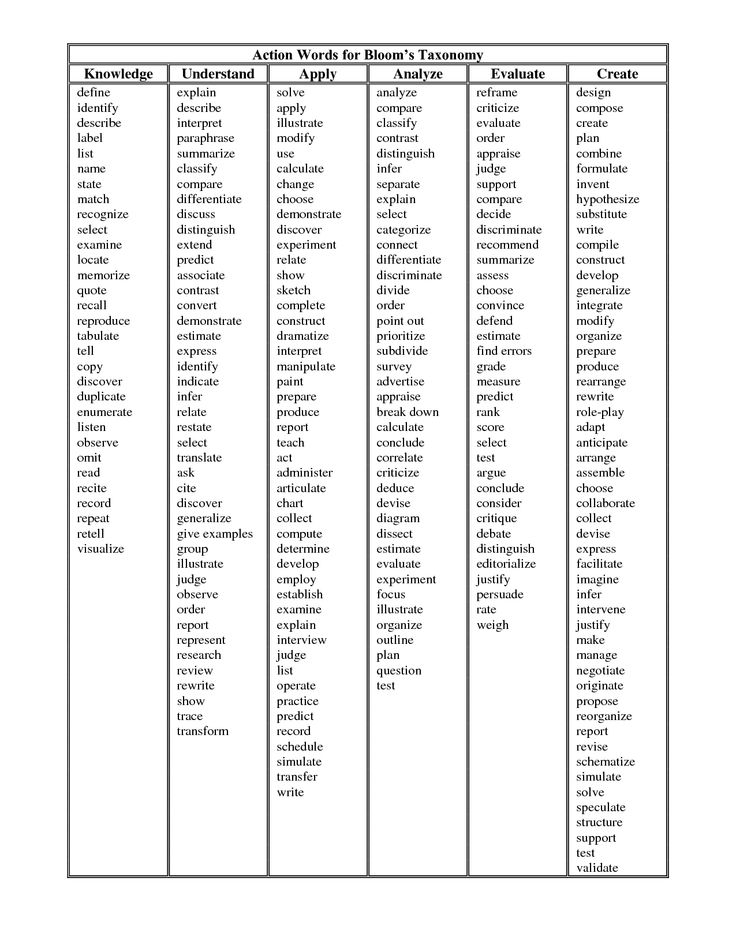
The concept of using Bloom's Taxonomy to differentiate instruction is not new. I have used this strategy for years but could it be taken a step further? Is it something with practice have students use the verbs to write questions while reading or working on an activity to differentiate what they have learned during the lesson using their own verbs to answer the questions? For instance, a student or team could look at the reading and cross reference with the chart below to figure out what the author of the text is asking. They could look at the questions being asked and look for the verbs to see what the author is asking. Students with practice could look at the lists to comprise their own questions and form their own understandings. I used this while completing some doctorate coursework and did the former but not the latter. What do you think? The article and chart below are in Teach Thought. How do you use Bloom's taxonomy in the classroom? If not, why not? The article below is currently on teachthought.com

     Bloom’s Taxonomy’s verbs–also know as power verbs or thinking verbs–are extraordinarily powerful instructional planning tools.
In fact, next to the concept of backwards-design and power standards, they are likely the most useful tool a teacher-as-learning-designer has access to. Why?
They can be used for curriculum mapping, assessment design, lesson planning, personalizing and differentiating learning, and almost any other “thing” a teacher–or student–has to do.
For example, if a standard asks students to infer and demonstrate an author’s position using evidence from the text, there’s a lot built into that kind of task. First a student has to be able to define what an “author’s position” is and what “evidence from the text” means (Knowledge-level). They’ll then need to be able to summarize that same text (Understanding-level), interpret and infer any arguments or positions (Analysis-level), evaluate inherent claims (Evaluation-level), and then write (Creation-level) a response that demonstrates their thinking.
Though the chart below reads left to right, it’s ideal to imagine it as a kind of incline, with Knowledge at the bottom, and Create at the top. You may not always need this kind of tool to “unpack” standards and identify a possible learning sequence, but it also works ideally as an assessment design tool. If students can consistently work with the topic in the columns to the right–designing, recommending, differentiating, comparing and contrasting, and so on, then they likely have a firm grasp on the material.
While we’ve shared Bloom’s Taxonomy posters posters before, the simplicity and clean design of the chart format make it a bit more functional–even useful to hand to the students themselves as a hole-punch-and-keep-it-in-your-journal-for-the-year kind of resource. It also makes a powerful self-directed learning tool. Start at the left, and, roughly, move right.
verbs-for-blooms-taxonomy
249 Bloom’s Taxonomy Verbs For Critical Thinking

Wednesday, February 4, 2015

Fulton County Schools learned today that it will be reaccredited for another five years by AdvancED


This comes from the Fulton County Schools communications department and is great news for an urban district that focuses so much on improving teacher and student achievement. Seeing first hand how much FCS works to ensure the success of every stakeholder, this is good news for the Greater Atlanta area where many people are working to make sure students can be gainfully employed and ready for a career and of course... become productive citizens.
 
 From FCSS Communications
 
EmployeesFulton County Schools learned today that it will be reaccredited for another five years by AdvancED, the parent organization of SACS (Southern Association of Colleges and Schools).

A 20-member external review team assessed the entire school district during February 1-4 and made its recommendation to Superintendent Robert Avossa and the Fulton County Board of Education this afternoon. Over the four-day period, the team interviewed nearly 650 system leaders, principals, teachers, students, families, and business/community partners. Preceding the visit, however, were months of preparation, artifact collection, and research documentation throughout the district.

AdvancED examined three main areas: impact of teaching and learning; capacity of leadership; and use of resources. It praised Fulton County Schools for exceeding national standards in providing learning environments that have high expectations and are equitable, supportive, active and well managed. It also gave high marks – called Powerful Practices – for the district’s leadership and school board governance, and for fostering a culture where all within the school system have a shared understanding of goals and direction.

“This is an intensive process, one that allows us to take a deep look at ourselves and to peel away our layers to evaluate our effectiveness and efficiency as a school system. We’re extremely proud that AdvancED recognized our schools’ hard work and our leaders’ efforts to provide a quality learning experience for all students.” said Linda McCain, school board president.

Acknowledging some limitations and challenges faced by the system, the AdvancED team pointed out that no school system is perfect and that many social and economic factors are beyond the district’s control. It identified some areas for improvement, particularly how digital learning is addressed in schools and a perception in the community that funding or resources may not be allocated the same among schools. It also shared that while some schools are high performing and continually seeking improvement, not all schools have the same focus on continuous improvement practices and processes.

“We know that there are some areas that need improvement and they don’t come as a surprise,” said Superintendent Robert Avossa. “Many already have direct plans for improvement, such as our digital learning environment, which is being addressed through our strategic plan’s focus on instructional technology and personalized learning. We are confident AdvancED will see great success in this area when we are reevaluated during the next five-year accreditation cycle.”

Fulton County Schools’ reaccreditation will be made official when the AdvancED Commission votes later this year. Being accredited by AdvancED signifies that a district and its schools are focused on raising student achievement, providing a safe and enriching learning environment, and maintaining an efficient and effective operation. In addition, it means that the school system adheres to high quality standards based on the latest research and successful professional practices.
In 2004, Fulton County Schools became the first school system in the nation to receive district accreditation. Before that, every school went through the accreditation process individually.
AdvancED is the unified organization of the North Central Association (NCA), the Southern Association of Colleges and Schools (SACS) and the Northwest Accreditation Commission (NWAC). AdvancED accredits more than 32,000 public and private schools and districts across the United states and in 70 countries worldwide

Monday, February 2, 2015

The Genius Hour Design Cycle: A Process For Planning

The Genius Hour Design Cycle: A Process For Planning

 
by Nigel Coutts, thelearnersway.net
Ed note: Part 1 of this 2-part series can be seen here; note that some of the language has been slightly revised from the original post by Nigel. He uses the term passion projects, which is very close to Genius Hour and Passion-Based Learning. The differences across the three terms are often a matter of individual use and interpretation, a point we wanted to help clarify by using the three terms interchangeably even though they may not be exactly the same–passion projects needn’t use a Genius Hour format, nor does passion-based learning necessarily need to take the form of projects. In that way, the above model can be used for any of the three, but it felt most precise as a model for teachers to use to design Genius Hour projects. So, here we are. You can (and should!) read more from Nigel at thelearnersway.net.
In an ongoing effort towards polishing the edges, over the years we have continued to refine the processes we apply to the Personal Passion Project. We have gained insights into the sorts of projects that work well and which will cause difficulties. We have added a degree of structure while maintaining the required degree of freedom necessary for a personalised project.
The results of this learning are presented (in the model above and the text) below.
1. Be prepared to be amazed
The quality of the students projects will go beyond what you expect. This is particularly important when a student comes to you with a grand idea that seems too hard or overly complex. If the student has the right level of passion for the project and an idea for how they will get started they will more than likely complete the project and complete it well.
2. Don’t let your fears get in the way
The students are almost certainly going to select topics that you have no knowledge of and don’t have the skills to support. At this point it could be easy to let your fears and insecurities get in the way. The best way to move forward is to listen to the student; do they know what they are doing? do they know which questions they need to answer? what problems they need to solve? If the answers to all of this are positive, start looking for an expert to help when times get tough.
3. Some students need a push in the right direction
Some students will come up with projects that are too simple with answers that could be easily Googled. We introduced the students to ‘High Order Thinking Skills’ and built these into the planning forms students complete. Projects need to include elements of synthesis, evaluation and creativity with the minimum requirement adjusted for individuals. We provide students with a list of verbs appropriate for the top levels of Bloom’s taxonomy and help them use these in framing their topics.
4. Some students design a project that has nothing to do with their passion
A student might have a passion for surfing and decide they are going to write a book about the history of the sport. The problem is they have designed a project where they will need to be a historian, a researcher, a writer and you know they don’t enjoy doing any of this. Maybe with the right topic they will gain a wider interest in these things but most likely they will quickly dream of days at the beach.
5. Some projects are just not possible
It can be hard to say no to a project but some are just not feasible. A classic example is the student who wants to design a better tennis racquet by selecting the right mix of shape and materials. The problem is that the modern tennis racquet uses high tech composites and even with million dollar R&D budgets the differences between one design and the next is hard to prove.
6. Time and Scale
Some projects will clearly take longer than you have available, others are simply too large in scale or will rely on the involvement of too many people. Setting manageable goals and working to an achievable timeframe is important. At the same time you need to ensure that the concerns over time constraints are genuine.
Creating a detailed timeline with estimates of how long each phase will take is beneficial on many levels at this stage. For the students the conversations around how long the project will take can include some rewarding reflection on how they approach tasks and can assist in their development of an understanding of their learning style. Some students need time to talk about their project and unpack ideas socially, others need quiet time to think through the steps, some just dive in and fix mistakes and redirect their plans as they go.
7. Too many changes
One of the challenges for some students has been the ever changing project. They select one topic, discover they don’t like it or encounter a problem they can’t easily solve and change to another topic. A week later and the process repeats. Setting a definite deadline after which there can be no changes is important. In the end the students work out that they have to make their ideas work.
8. Just enough planning
Over the years we refined the level of planning the students were required to do before commencing on their projects in earnest. The initial version required great detail and length processes for developing focus questions and setting targets. For some students and some projects it worked well but for others it got in the way. Eventually we got to a point where the planning had just enough detail, so we know the students have an understanding of their project and that we can support them along the way. View our simplified planning template
9. Relying on experts and building a team
Many of the projects students have explored over the years fall outside of the expertise of their teachers. I have no idea how to sew for example and have been of equally little help to students who are basing their projects around dance or music. Across the school we have found amazing partners with the skills we needed and in most cases they are keen to spend time with a student who they share a passion with. Building a team of support around the project is key to its ultimate success. Being mindful of the workload within this team is also important. We have had some colleagues so keen to help that they become overloaded and although they never complained we had to be careful in managing the demands on their time.
10. Collaboration & Self Organized Learning
Because this is a Personal Passion Project we have not included team projects. Nevertheless collaboration between students is an important part of many projects. Where possible foster the opportunities for collaboration while allowing each student to maintain control of their project. The power of collaboration will lift the quality of the projects as students share ideas and encourage each other to go beyond expectations.
Collaboration will also solve some of the problems with projects outside the teacher’s comfort zone. This year I had a group of students focused on game development and their ultimate success was a direct result of the community of like-minded learners they created around their projects. This is a perfect demonstration of students adopting a self-organized learning environment as they connect with their passions.
11. The invisible safety net
For the Personal Passion Project finding the right levels of scaffolding, teacher input and guidance is one of the challenges. We want the students to feel that they are working independently while maintaining an appropriate level of support. In many ways we are wanting to provide an invisible safety net that allows the students to take risks independently while having the support they require.
12. Documenting the process and ensuring time for reflection
Giving time to active reflection on the process has been important. Students need to be able to take a step back and assess what they have achieved and what remains to be accomplished. Sharing these ideas with peers is most beneficial and allows you to train the students in reflecting on their learning and in giving feedback to their peers.
The act of reflecting on the process has also benefitted many students when it is time to share their projects with the world as their audience is as interested in the process as they are in the product. This is particularly true for projects where the process is not obvious or is underestimated by the audience. A good example is game design projects in which the finished product does not reveal the level of knowledge and effort that was required.
13. Real Audiences
For all learning adding a real audience for the students is critical, too much of what students do is produced for an audience of one. For the Personal Passion Project presenting to an audience in the end of term ‘Gallery Walk’ has been critical in ensuring the success of the projects. The students gain a real sense of achievement from this day and the feedback is always genuinely positive.
For 2015 we are planning to move to a ‘Genius Hour’ model with students engaging in a scaffolded programme of project management skill development throughout Semester One that leads into planning for and completing a Personal Passion Project across Semester Two. The difference will be that the learning experience will be distributed across the year, one hour per week.
We hope that this fits with the demands of the new syllabus from a time perspective while retaining the best parts of the present model. Certainly at the end of the year we will reflect and share what has been learned.